Explorer: from discovery to action
The Signet/Tempo explorer, and what changes when its interface becomes configurable infrastructure.
Inspect artifact ↗A block explorer often begins with a hash. The Signet explorer also provides ways to discover an account or contract, inspect orders and participants, and enter an action flow. That changes the role of the page: it can help someone find a place to begin, as well as explain a transaction that already happened.
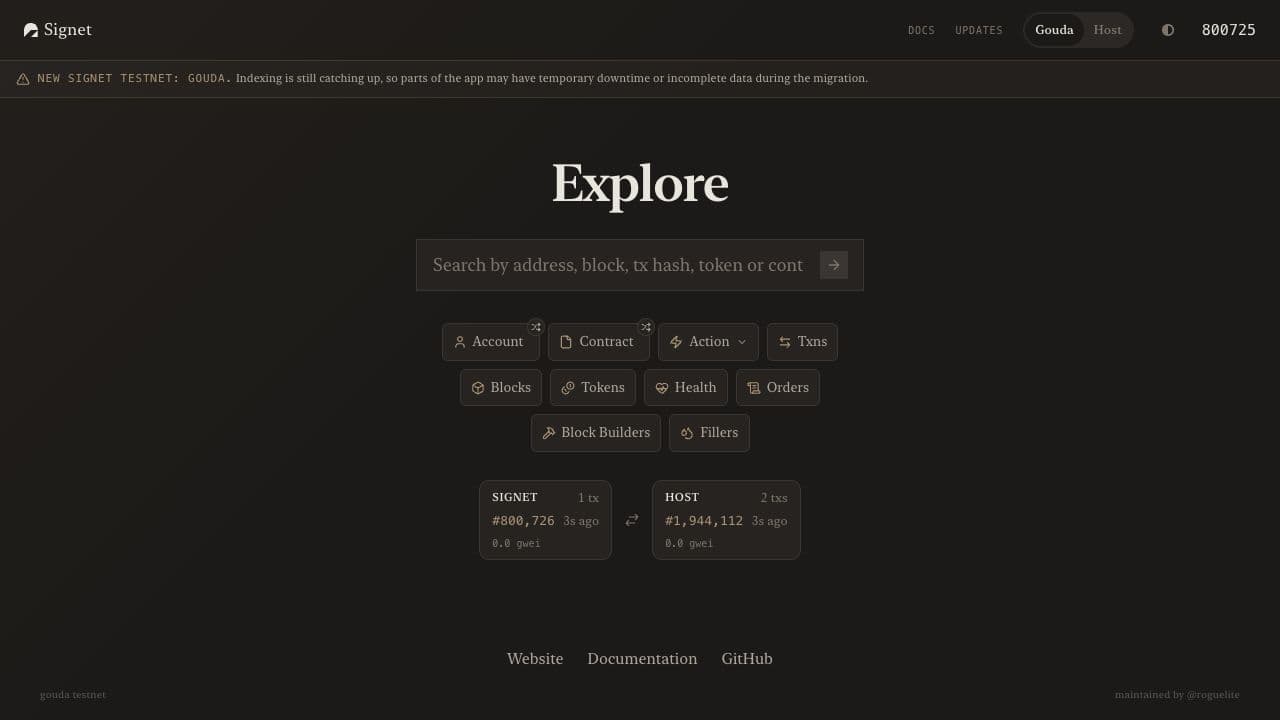
Make the available actions explicit
The inspected actions route defines six tabs and brings in panels for sending, entering, wrapping, deploying and funding alongside the swap flow. The actual implementation carries wallet state, network switching and transaction-specific error handling. An article illustration should preserve those boundaries rather than turn the flow into a fake successful transaction.
const TAB_VALUES = ["swap", "send", "enter", "wrap", "deploy", "fund"] as const;
type Tab = (typeof TAB_VALUES)[number];- Search / discover
- Inspect account or asset
- Select an action
- Wallet + chain requirements
- Transaction outcome
The open-source variant has a different contract
Open Explorer is a related fork of Tempo Explorer, extended with multi-chain support and a configurable token registry. Its current README targets OP Stack testnets and lists five configured networks. Chain metadata lives in src/lib/chains.ts; canonical token definitions and Blockscout endpoints are separate configuration concerns.
Applying it to another supported network begins with the chain definition: ID, currency, RPC and explorer endpoints. Then configure the token registry, check Blockscout compatibility, and verify that requests and caches remain scoped to the selected network. A new chain is a data contract to validate, not just a new option in a selector.
Do not inherit claims from the first deployment
The current Open Explorer README explicitly disables protocol actions and builder, filler and order telemetry until each network has a verified data contract. That distinction belongs in the essay. Signet-specific behavior cannot be assumed to work on an arbitrary chain, and the present implementation does not justify an any-chain compatibility claim.
The screenshot shows Gouda. The source excerpt comes from a checkout whose README names Parmigiana. They document different revisions; the excerpt does not establish that every pictured action runs that exact code.
The public site is the available outcome. This review did not connect a wallet or submit a transaction, and the pictured Gouda deployment differs from the related Parmigiana source revision.